As I shared in my last post, I have been carefully examining the excellent work of the late Ruth Merner Connell who self-published a genealogy of Ellen's ancestral Merner family in 1976. The book has been an excellent resource helping me to add on to the Merner family information I had already discovered. As I have entered each fact into my genealogy database from the Merner genealogy book, I am careful to ensure that nothing is entered without a source citation.
In addition I have been 'auditing' the contents of the book to ensure that the facts it presents can be verified with primary source documents, something that Ruth Connell used when available but didn't always have easy access to. I am about half way through the book and have been impressed to find that about 98% of the facts it contains are accurate. Small errors occur likely due to typographical errors (the book is about 600 pages long and each paged was typed on one of those old-fashioned things called typewriters).
Among the stories that I have uncovered was that of Irene Nelda Merner, Ellen's second cousin twice removed. Irene was a great granddaughter of Ellen's 3X great grandparents Jacob Emanuel Merner (Muerner) and Susanna Schluchter.
Irene's father Ammon Merner was a hard working machinist/moulder who worked in the town of Waterloo, Waterloo County, Ontario where Irene was born in 1890. At the age of 26, in 1916, Irene married a young man from Berlin, now Kitchener, Ontario, named Weybourne Doerr. The newlyweds settled into married life in Kitchener and in July of 1917, their little family expanded when their first child, a son they named Carl Merner Doerr, was born.
The year 1918 however brought tragedy to the family as both Irene and her husband Weybourne died, within two days of each other, as a result of the 'Spanish grippe' or pandemic flu. Carl was orphaned at just fourteen months of age and would be raised by his paternal grandparents, Charles Henry Doerr and his wife Susannah Wagner.
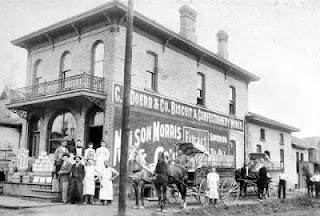 Grandfather Charles Doerr had established and operated a small 'grocery' store and biscuit bakery in Berlin, Ontario. Charles brought his grandson Carl into the business and began teaching him the ways of business world. In 1941, when he was just 24 years of age, Carl was forced to take over the business when his beloved grandfather died.
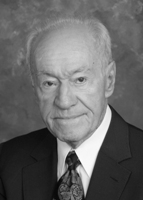 Carl, Ellen's third cousin once removed, continued to grow the business and in 1945, he changed the family and company name to Dare. The company is now one of the largest food companies in North America, known for Melba Toast, Viva Puffs, Bear Claws, Real Fruit Gummies, Wagon Wheels (one of my favourites as a kid), and a large variety of cookies. Carl's Dare Foods company was the first to introduce the resealable tin tie bag in 1954. Not only was Carl a great entrepreneur but he also demonstrated great philanthropy through contributions to the local symphony, hospital, conservation authority and through his foundational work in establishing the University of Waterloo.
Carl Dare/Doerr was inducted into to Waterloo Region Hall of Fame in 2008.
Take away all of the current databases and you are left with the archives, cemeteries, registry offices, courthouses and unknown family members that Ruth Merner Connell had available to her when she decided, in 1971, to explore her Merner ancestry. Ruth is pictured below with her husband Robert Connell in a screen shot captured from her book.
Six years after she began 'climbing her family tree, Ruth produced, and self-published with the financial assistance of a Merner cousin, the almost 600 page book, Murner, Muerner, Merner: genealogy and related branches. The book, now out of print is available to be viewed as images on a page by page basis through Ancestry as well in several library special collections and genealogy society holdings.
Ruth Merner Connell used Jacob Emanuel Merner and his wife Susanna Schluchter, Ellen's 3X great grandparents, as her starting point for research. As Ruth, whose exact cousin connection to Ellen I have not yet determined, soon discovered, Merner family members were to be found all across North America, Europe, Africa, and even in Japan.
Ruth chose Jacob Emanuel Merner as her starting point as he was the first Merner to arrive in North America. She worked backwards from Jacob and Susanna using the Family History Centers of the Church of Jesus Christ and the Latter-Day Saints along with letters written to records office in different villages and towns in Switzerland. She even made regular contact with the Consulate of Switzerland in Cleveland, Ohio, not far from where she lived.
The records she found allowed her to trace her Merner ancestry back to Gwer Murner, born in 1545. Ruth was able to locate and identify records showing the eleven children of Jacob and Susanna who lived to adulthood and the ninety-three grandchildren they produced for their parents. New Hamburg in Waterloo County, Ontario, Canada became the central location from which the Merner family branches would fan out.
Ruth kept at it and found living Merner relatives through what had to have been onerous amounts of letter writing, receiving over time additional information about the lives of Merner descendants, usually derived from family bibles. Strangely, Ellen's connection to her Merner great-grandparents is not documented in the book as, unfortunately not all branches of the family responded to Ruth's letters requesting assistance with her project.
All of this was completed without a computer and was eventually, organized and published for the benefit of someone like me who came upon a connection to the Merner family, through marriage, and who unlike Ruth, can enjoy the fruits of her labour quickly through online resources providing me with information for my computerized genealogy database.
I began researching my family history about five years after Ruth's book was published. There were no computers and online was where you hung the clothes to dry. It was really tough work, not the least of which was figuring out how various archives organized and stored the records you wanted to review. You had to spend time learning the filing system before you could even hope to actually look at a microfilm reel of records. I wasn't very successful and so I am all that more amazed at the success that Ruth had and even more appreciative of her efforts.
Sadly, Ruth passed away at the much too young age of 57 in 1983. A true genealogist and a gift to future Merner researchers like me.
Anna Merner (name variant Muerner) was the seventh of eleven children born to Jacob Emanuel Merner and Susanna Schluchter. I married Anna's great-great granddaughter 179 years after Anna took her place in the Merner household in the Canton of Berne, Switzerland in 1824.
I don't know when Jacob and Susanna Merner brought there family to Canada but they had arrived by the time the delayed Census of 1851 covering Canada East, Canada West, New Brunswick and Nova Scotia was compiled in January of 1852. The family can be found in the village of New Hamburg, located in the County of Waterloo in what is now the province of Ontario. The Merners would come to be long associated as one of the leading families of this community for years to come.
While New Hamburg may have served as the family 'seat', it was also the launching pad for family members seeking adventure and prosperity in other parts of North America. For example, in 1875, Jacob and Anna's son Johan set off for the United States where he settled on a farm of his own in Cedar Falls, Iowa.
While a number of Merners ventured shorter distances to surrounding towns and villages in what is now southern Ontario, some saw the opening of Canada's west as their ticket to a better way of life.
And so it was that Levi Merner struck out with his young family in the late 19th century. It is believed that Levi died enroute to his dream, probably in 1900 in what is now the province of Manitoba. His widow, Mary Merner however 'soldiered' on and can be found living with her children in Didsbury, Alberta in 1901. Levi and Mary Merner's descendants can still be found enjoying the beauty and richness of Canada's western provinces today.
I owe a debt of thanks to Ellen's fourth cousin Glenn Swanson for contacting me, through this blog, and providing some of the breakthrough information that assisted in deepening my knowledge and understanding of the family.
In my last post, "Christmas Came Early To My Genealogy Land," I wrote about a new family connection provided by my wife's 4th cousin, Fraser Laschinger. Fraser and I had connected after he had left a comment on a blog post about Canadian Senator Samuel Merner, an ancestor he shares with my wife. Following a series of emails and 'snail mail' exchanges, here is how the Laschinger family branch was uncovered.
The information that Fraser had, compiled several years ago by Laschinger family members, indicated that Mary Merner (or Muerner) married Joseph Laschinger, probably around 1845. Mary Merner was the younger sister of my wife's great great grandmother, Anna Merner. Although I have yet to find a record of the marriage (it pre-dates civil registration in the Province of Ontario (or Canada West as it was known at the time), there are many records showing Joseph and Mary together as husband and wife along with their twelve known children. In fact, the 1851 Census of Canada West (the census was actually delayed and not actually taken until January 1852) records that Joseph and Mary Laschinger were living in Wilmot Township, Waterloo County, Canada West with their eldest three children. Their immediate neighbours were Jacob and Susanna Merner, Mary Laschinger's parents.
Although Joseph's occupation is listed as carpenter in the 1851 census records, the family eventually moved to New Hamburg in Waterloo County where subsequent census records and directories record that Joseph farmed his property as a living. Joseph passed away in 1881 at the age of 61 years and was buried in New Hamburg's Riverside Cemetery. His wife, Mary (Merner) Laschinger died of pneumonia in 1899 in Elmira, Waterloo County.
Of their twelve known children, I have found evidence so far that at least seven married and I have found evidence of 84 descendants. I am certain there are many more to be found across all parts of Canada and the United States. The search continues ...
 Grandfather Charles Doerr had established and operated a small 'grocery' store and biscuit bakery in Berlin, Ontario. Charles brought his grandson Carl into the business and began teaching him the ways of business world. In 1941, when he was just 24 years of age, Carl was forced to take over the business when his beloved grandfather died.


+Jacob+E.jpg)
+Susanna+Schluchter.jpg)